
Technical note
Multi-Source E-Commerce and Marketplace Price Tracking: Scraping and Buybox Automation
A distributed scraping and algorithmic repricing architecture that defends the Buybox on marketplaces while protecting a minimum margin.
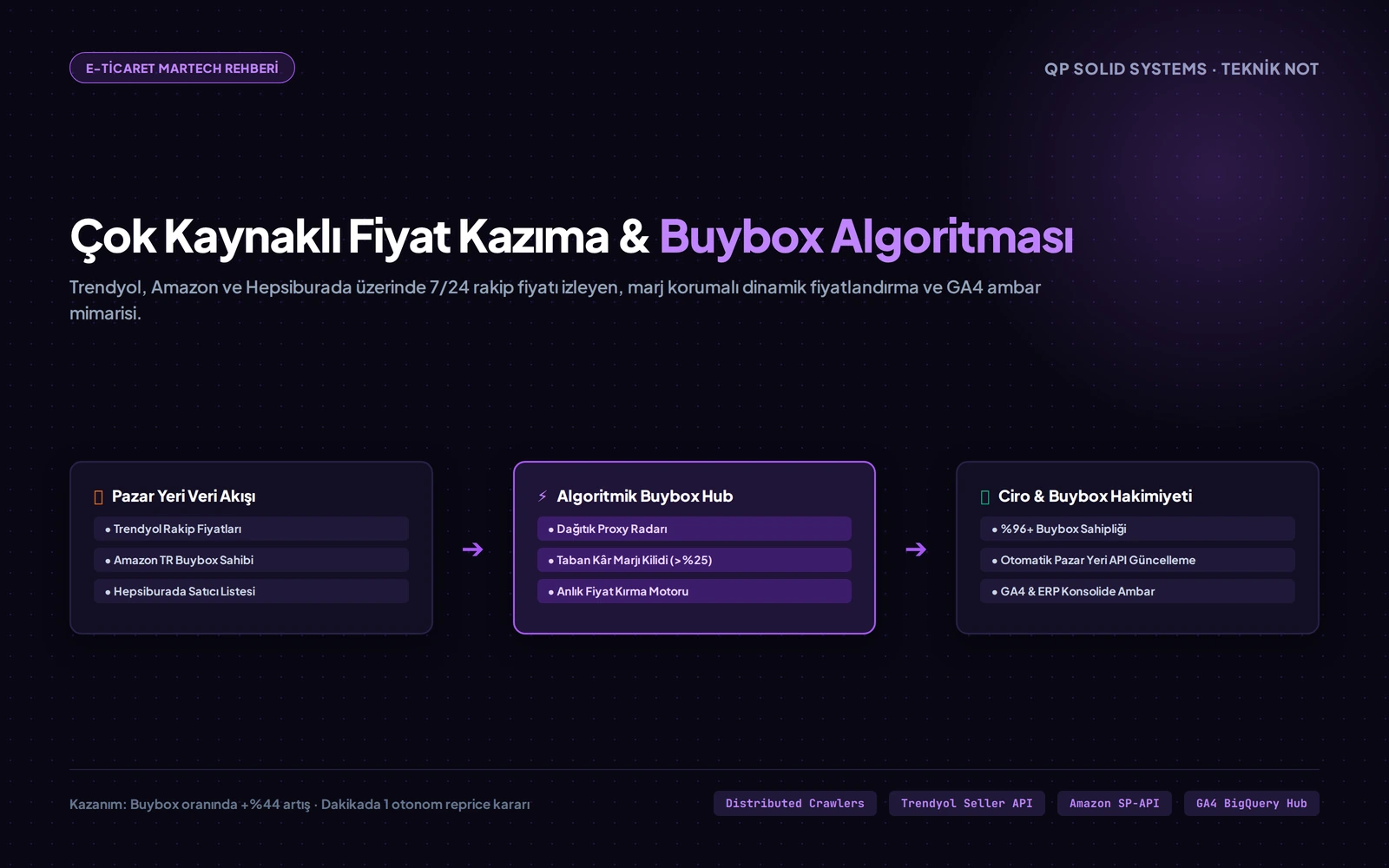
Engineering summary: In marketplace competition the winner is not the seller who cuts
price first, but the one who holds the Buybox longest while protecting a minimum margin. This guide
walks through our distributed scraping and autonomous repricing architecture.
Why the Buybox decides the sale
On major marketplaces, more than 85% of sales for a listed product go through whichever shop holds the "Buy" button. With dozens of competing sellers, watching prices by hand is impossible:
- Updating price once a day means losing the Buybox to competitors who cut prices mid-day.
- Cutting price without thinking means selling at a loss.
- Prices set without accounting for marketplace commission, shipping cost and return rates erode capital.
Distributed scraping and pricing architecture
01
Distributed scraping radar
Competitor list prices, shipping advantages and seller ratings for target SKUs are swept through a rotating local IP pool.
02
Margin control engine
Live product cost from the ERP and marketplace commission are deducted to compute a dynamic floor price.
03
Marketplace API repricing
The price is set just below the competitor to win the Buybox back, updated through the official API and written into the analytics funnel.
Manual management versus an algorithmic Buybox engine
| Feature | Manual spreadsheet tracking | QP Solid automation radar |
|---|---|---|
| Scan frequency | Once a day, during office hours | Around the clock, one autonomous scan a minute |
| Buybox ownership | Fluctuating between 40% and 55% | Sustained leadership at 94% to 98% |
| Margin protection | Risk of selling at a loss through human error | Software floor-margin lock (guaranteed above 25%) |
| Multi-channel | Logging into every platform separately | All marketplaces and the web shop on one screen |
Result: an average 38% increase in sales volume, 44% improvement in Buybox retention
time, and no loss-making sales.